
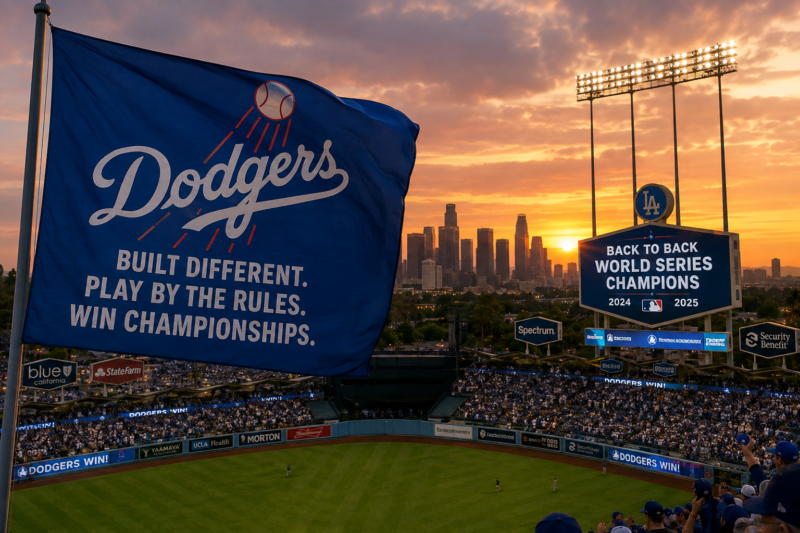
The trade deadline ended yesterday and once again, everyone hates the Los Angeles Dodgers. Womp, womp!
Skubal is a Dodger
Detroit traded Tarik Skubal, the back-to-back Cy Young winner to the Dodgers for three minor league prospects. Did the Brewers, Braves, or Yankees even try to make offers to Detroit? This trade wasn’t about money; it was about prospects. Every single team could have made offers. But they didn’t. Every team let Skubal become a Los Angeles Dodger.
The American League is wide open and Detroit simply gave up Skubal. Basically, Detroit gave up on this season. At least they got two of the top 100 prospects knowing they won’t be able to afford Skubal next year. But still, Tigers fans, your owners and GM didn’t believe in your team to make a playoff run; they gave up.
The Dodgers are NOT ruining baseball
No, the Dodgers are not ruining baseball. Players would tell you that they are making baseball better. With one of the best farm systems in MLB, the Dodgers draft well and develop talent. The Dodgers have developed a brand in a market that pays well AND they reinvest into winning.
When you invest in your brand and winning, the fans will support you. The Dodgers have led MLB in total attendance 39 out of the last 40 years and didn’t win a WS from 1989 through 2019. I bet the Dodgers lead the league in road game attendance too. Thanks to the fan group Pantone 294 who organize fan travel and they take over full sections of stadiums adding to the revenue. If anything, the Dodgers are not ruining baseball, they are making baseball better.
The Athletics (A’s) constantly lead MLB in lowest payroll and lowest attendance. Similar trends are true for the Cleveland Guardians and the Miami Marlins. But the Guardians make noise in the postseason meaning drafting and developing players is just as important as making money. So no, the Dodgers are not running baseball, blame the owners who are not investing in their team on and off the field. (The A’s are moving to Vegas in 2028- so at least they are trying to be better in the future.)
Moneyball
Remember the movie, Moneyball, based on a true story about small markets using analytics to win? Well, that advantage was short lived when the big markets adopted the same analytics.
The Dodgers just play a different game of Moneyball. They take full advantage of the rules, payroll structure, and they spend big. The Dodgers are doing everything they should to win within a system that allows it. Don’t hate the player, hate the game- or Dodgers President of Baseball Operations Andrew Friedman for being the absolute BEST at his job. Imagine having a boss who is obsessed with winning and is really good at his job? Yea, I’d hate Friedman too if he worked for a different team.
The real Moneyball analytics here is: if you’re mad at the Dodgers for making a lot of money AND for spending a lot of money, you should really be mad at the cheap owners for not trying to win.
Show Me the Money
You want to argue it’s not fair for small-market teams vs big-market teams? Okay, let’s look at the Anaheim Angels (I will not call them the ‘Los Angeles’ Angels.) The Angels and the Dodgers are in the same big market and they both are two totally different teams. National and local media make up about 49% of teams’ revenue. (Local TV makes up about 22% of the media revenue.) Also, teams with big local TV deals have to pay the Local Revenue Rule where THEY pay 48% into the smaller market TV deals.
Both the Dodgers and the Angels have the opportunity to receive the same local TV share. However, if you really want to see where the differences come from, step up to the plate. Ticket sales are 31% of teams revenue and the remaining 20% comes from concessions, parking, sponsorships, merchandise, and licensing.
The Angels average 33K in attendance and have about a $200M payroll. Above average attendance and average payroll with one of the best players in baseball, Mike Trout on the team. But the last time they made the post season was 2014. From 2018 – 2023 they had Trout AND Shohei Ohtani on the team. Two generational players and they never finished better than 3rd in their division. That’s called poor management, a weak farm system, and a terrible front office. The point is, you can have the money, a big market, and big-time talent, and still suck! AND they pretty much let Ohtani become a free agent.
CBA
With the current Collective Bargaining Agreement (CBA) is set to expire on December 1, 2026, a lockout is anticipated. Haters want to blame the Dodgers, but I’d blame the cheap owners. The primary reasons for the lockout are the difference in competitive balance, luxury tax, and deferral economics. Basically, the small market owners will be the reason for a lockout. Here’s why.
Competitive Balance
To even the competitive balance, small market owners want salary caps to help ‘even’ the playing field. I would argue, how about small market owners met a minimum salary and actually pay your players instead of owners’ shares. (Every MLB team makes money, if they say they are not making money and not selling the team- they are lying to you.) Only small market owners want a salary cap. Players and big market owners do not want salary caps.
Luxury Tax
The Competitive Balance Tax (CBT), commonly known as the luxury tax, acts as Major League Baseball’s “soft” salary cap. Unlike other leagues, MLB does not have a hard salary cap. The luxury tax is primarily used to prevent high-revenue teams from completely monopolizing top talent. When teams spend over the base tax threshold ($244M for 2026) they are penalized by paying a luxury tax on the amount over. Each consecutive year the team exceeds the threshold, the luxury tax increases: Y1 20% Y2 30% Y3 50%. Players do not want the luxury tax in its current form. Players argue it acts too much like a hidden soft salary cap that scares mid-tier teams from spending. Instead, they want a higher threshold and a league minimum for team salaries.
Deferral Economics
Now it gets real fun. Deferral economics in Major League Baseball centers entirely on the financial concept of the Time Value of Money (TVM): a dollar available today is worth more than a dollar promised in the future because of its potential earning capacity and inflation. By pushing player salaries decades into the future, big-market teams can take advantage of an accounting mechanism that significantly lowers their current luxury tax hits and frees up immediate cash flow.
To summarize, I’ll use Ohtani. He signed a 10-year, $700M contract with the Dodgers. He takes home just $2M per year now, deferring $680M until 2034–2043. With $680M being paid a decade from now it’s worth far less in today’s economy and the league discounts the contract’s real value down to roughly $460.8M. This means that instead of Ohtani counting for a massive $70M against the Dodgers’ annual luxury tax payroll, his Average Annual Value (AAV) hit is lowered to just $46M per year. It’s bleeping genius and 100% legal. Only small market owners are against deferral economics.
Just ask the Mets, money doesn’t buy you a World Series. It absolutely helps. It’s more than just about money so stop hating on the Dodgers becoming the smartest team at playing by baseball’s rules. And with Skubal being a short-term rental, the Dodgers are trying to win a third consecutive World Series. Let’s Go Dodgers!
You can help keep the posts coming! Donate any amount, I would really appreciate your support! https://alisonstclair.com/donate/